Tuesday, March 24, 2015

On The Other Side of the Camera...The Reporter

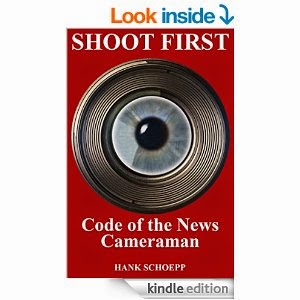
Hank Schoepp’s memoir "SHOOT FIRST: Code of the News Cameraman" spans 29 years (1968-1997), a significant period in television news history. While on assignment for KPIX/CBS 5 in San Francisco, he captured events through the lens of his camera which commanded regional, national and worldwide attention.

Reader Suzanne Flores asks Schoepp about his experiences working with his colleagues on the other side of the camera.

Flores:  As a news cameraman, no doubt every work day experience was a different "story", but I can imagine that this dynamic would vary greatly depending on who your partnering reporter was for the assignment. Can you tell us about your working relationships between the personalities of different reporters, and remark on some of the experiences you've had while working with reporters?
 
Schoepp:  First of all, as a cameraman shooting the news, you need to be able to "size up" or "get the feel" of who you are working with.  If it's for the first time, this must happen in very short order.  You don't have the luxury of a gradual process of familiarity.  You are assigned to cover a story together, right now, as a team: he or she with words, you with pictures.  Sometimes ego gets in the way, on either side.  In which case, I would prefer not to mention the name of the reporter who, because of a demeaning attitude and verbal abuse directed toward me in front of others, I left standing at the curb when I wrapped the assignment and drove off on my way back to the station.  Fortunately, this never happened more than once, and I am privileged to have only fond memories of my working relationship with countless other reporters throughout my long career. 
 
Flores:  Tell us more about some of your fond memories. Who were some of your favorite reporters to work with, and why?
 
Schoepp:  Twenty-nine years saw a great many reporters come and go at KPIX, and with fond memories of my working relationship with almost every one of them, it would a take another book to tell all their stories.  However, there will always be someone who you remember and who stands out for a particular reason. 
 
    Mike Hegedus impressed me as one who had complete control of a feature story.  Every time.  He knew in advance exactly who to interview, what to say during his stand-p to the camera, and, most important, left me to my own devices, deciding and shooting whatever B-roll I felt we needed. 
 
     Pam Harper had what I used to call the "gift of approach."  She had that rare combination of professional savvy and sensitivity to victims of a tragedy which, on more than one occasion, we experienced while telling a news story under difficult circumstances.
 
     Whenever Rolando Santos spoke to my camera and microphone and the viewers at home, he would ask for my opinion afterwards, not only on its content but on his appearance while delivering the stand-up.  And, from time to time, he would comment about how he felt more destined toward a career in news management rather than reporting in the field.  Some years later, after holding managerial positions at various other television stations around the country, Rolando settled in Atlanta as president and head of CNN.
 
     And some reporter/cameraman partnerships just end up as long lasting friendships.  That's what happens when two great minds are required to think alike.  In all modesty, coming up with original and entertaining ideas and then producing over two hundred Car 5 feature stories in a single year doesn't happen by accident.  Needless to say, working alongside reporter John Lester in 1979 was one of the highlights my entire career.  
-----
 
Veteran news cameraman Hank Schoepp, who worked for San Francisco’s KPIX/CBS 5 from 1968-1997. His book covers a one-of-a-kind view on some of the biggest stories of that time.
 
Read more about the stories captured by Schoepp and many of the high profile reporters of that time.  Click here to purchase the book- $4.99 on Amazon.  "SHOOT FIRST: Code of the News Cameraman"


Tuesday, March 17, 2015

KPIX/CBS Presents a Tribute to Hank Schoepp's Career


Hank Schoepp's career at KPIX/CBS spans 29 years (1968-1997), a significant period in television news history.  While on assignment in San Francisco, he captured events through the lens of his camera which commanded regional, national and worldwide attention.

Click here to view a KPIX/CBS tribute to Hank Schoepp's career

https://www.youtube.com/watch?v=2G2_SyPDteU&feature=youtu.be&noredirect=1


Website
Shoot First: Code of the News Cameraman on Amazon
Email

Sunday, March 15, 2015

Industry Colleagues Endorse "Shoot First: Code of the News Cameraman"

"If you've ever wondered what it takes to bring you that 90 second report on the evening news, Shoot First gives you a true insider's look.  Hank Schoepp takes you on a journalist ride through some of the biggest stories of the last three decades. Hank was there for all of them and offers a fascinating account of the people, pressures, and the perspecitve that only an insider could have. A first-rate, first-hand look at life behind the camera lens of a veteran news photographer."
---Kate Kelly, Anchor/Reporter, KPIX/CBS San Francisco

"A wonderful living history as captured through the lens and mind of a great television news photographer.  His insights now are as sharp as his focus when it was happening."
---Ron Magers, Anchor/Reporter, WLS/ABC Chicago

"Hank Schoepp lived and worked as a news cameraman during one of the most exciting periods of San Francisco history.  Through his viewfinder we get an informed, inside look at the major stories which captured that era, for San Francisco and for the nation."
---Kevin J. Mullen, San Francisco Deputy Police Chief, retired, author of Chinatown Squad: Policing the Dragon from the Gold Rush to the 21st Centery


Website
Shoot First: Code of the News Cameraman on Amazon
Email

Friday, February 27, 2015

Shooting for Pool at the Patty Hearst Kidnapping Trial- 1976

Shoot First: Code of the News Cameraman

Book Excerpt:

Chapter 15: 207

 
The police code for a kidnapping is 207…
On February 4, 1976, two years to the day following her abduction in Berkeley, Patty Hearst appeared in Federal District Court in San Francisco for the beginning of her trial.  It lasted two months.  During that time, the assignment desk sent my camera colleagues and me to cover all bases at the Golden Gate Avenue location: the press room on the twentieth floor, where attorneys and anyone else qualified to face the media sat behind a large table clustered with microphones; the entrance to a down-ramp leading to the parking garage under the building where a vehicle carrying Hearst arrived each morning; and inside the garage, where, on several occasions, I was the pool camera selected to capture the defendant on film.  Firing off a motorized rapid shutter, a still photographer worked alongside me as pool for newspapers, wire services and the like.  Afterwards, the film we shot would be rushed to a lab to make copies for other media organizations, which qualified by having their cameras positioned elsewhere at the scene of the story.
Routinely, a United States Marshall escorted the still photographer and me down to the garage beneath the Federal Building and stayed with us for Patty Hearst’s arrival.  Oddly enough, security at the closer San Francisco County jail on Bryant Street was deemed inadequate, and Hearst was transported each day of the trial from the San Mateo County jail in Redwood City, some twenty-five miles away.  Silhouetted by sunlight outside the ramp, the vehicle carrying Hearst would enter the garage and pull into a parking space a short distance from a waiting elevator.  That didn’t leave a lot of time for film footage, but the marshals were running the show here.  For maximum end-to-end coverage, my lens would be pre-focused, camera already rolling and battery light burning at the very first sight of them.
Patty Hearst's Parents- Photos courtesy of KPIX/CBS 5
Janey Jimenez was appointed personal guardian to Patty Hearst and usually preceded her when stepping from the car.  She was a fine looking woman in her uniform of a United States Marshall. Because of her role, she became a celebrity in her own right.  She was soon followed out of the vehicle’s back seat by the passenger in her custody.
My first impression of Patty Hearst at closer range was of how much shorter she appeared than in the pictures I had seen of her, including the one from the Hibernia Bank.  (Toting a semi-automatic weapon tended to add a few inches.)  Here, she was frail, a bantam weight in the neighborhood of ninety pounds, her face pale and drawn, sad eyes, mostly downcast, adding all the more to her vulnerability.  She seemed to me like a small bird, wings clipped (and handcuffed), removed from one cage and placed into another.  Filming became a matter of first-you-saw-her, then-you-didn’t, from car door to elevator door in fifteen seconds, in frame but out of sight, as the elevator door closed between us.
Shooting pool camera was almost the same as shooting for a single television station, with one exception.  If you screwed up, lost your film loop and had a camera jam or fell on your ass while walking backwards, then every other station, network, cable channel, foreign television, or broadcasting outlet in need of pictures that moved screwed up too.  They ended up empty-handed, and you with egg on your face.  Knock wood, it never happened to me.  But additional pressure was always brought to bear whenever assigned as a pool camera, which was why it was more often assigned than volunteered.
 

Thursday, February 12, 2015

Announcing, Shoot First: Code of the News Cameraman

Veteran news cameraman Hank Schoepp, who worked for San Francisco’s KPIX/CBS 5 from 1968-1997, has released a memoir on Amazon.com. His book covers a one-of-a-kind view on some of the biggest stories of that time.

Before he was a news cameraman for KPIX/CBS, Hank Schoepp was a photographer's mate in the United States Navy and an animation cameraman at Walt Disney Studios.  His military tour (1953-1957) involved a myriad of assignments: picture documentation of fleet manevers, missile launches and aerial reconnaissance photography among them.  His entertainment tour (1958-1960) included work on the full-length animated features Sleeping Beauty and 101 Dalmations, one frame at a time. 

Ultimately, Schoepp's career path, as originally planned in the film industry, took a different turn.  Instead of being the member of a camera crew telling a story through images over a given period of time, he found himself telling visual stories on his own each day while shooting the news for television.

The author is blessed in abundance through his family: a son and four daughters, twin grandsons and five granddaughters.  Having retired from the video firing line, he now lives with his wife Drue in Las Vegas, following the news on television like most everyone else: as spectator rather than participant.

Website
Shoot First: Code of the News Cameraman on Amazon
Email


.

Thursday, January 29, 2015

Now Available on Amazon- Shoot First: Code of the News Cameraman

http://www.amazon.com/Shoot-First-Code-News-Cameraman-ebook/dp/B00SXKFWGG/ref=sr_1_1?ie=UTF8&qid=1425232885&sr=8-1&keywords=hank+schoepp


Many books have been written by and about broadcast journalists with interesting things to say. And yet few have spoken on behalf of those who perform on the other side of the camera lens. Finally, that voice is heard loud and clear with SHOOT FIRST: Code of the News Cameraman.

Website
Shoot First: Code of the News Cameraman on Amazon
Email